The Long Call option
Buying a long call option contract will give the investor the right to purchase the underlying asset (stock or ETF) at the strike price. [1][2][3][4][5][6]
If the invester believes the asset price will increases quickly and significantly in a short period of time, the long call option will let the investor possible profit from higher asset price, gain leverage with cheaper option cost.
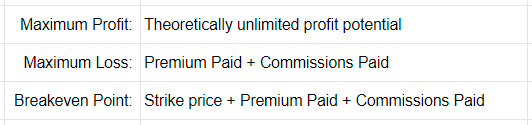
The Long Call option trading strategy is a simple strategy for beginner to try. It is a Limited Risk strategy with maximum loss as Premium Paid + Commissions Paid, and no Assignment Risk.
For example, on 07-08-2020, to buy BAC Call 16-10-2020 with strike price $31, the premium was $0.32. The broker commission is about $0.65 to $1 per contract. So we will pay about $33 per contract (for 100 stock shares). If we do not close this contract before the expiration date, e.g. 16-10-2020, the maximum loss is $33.
To learn the option trading, we have to choose a strategy to start with. When planning to buy a long call option, we will learn a lot of option trading concepts and terminologies, such as Long, Short, Call, Put, Strike Price, Premium, Expiration, Assignment, To Exercise, Implied Volatility, Delta and many many.[7][8][9]
Plan $30 to $60 for each option deal. Many options with 45 to 60 days to expiration are near $25 to $30 per contract (or premium is near $0.25 to $0.30). Select the stocks or ETFs that are in up trend, in general, the stock price should higher than its Simple Moving Average (SMA, or MA) 5 days price (MA5)[10]. Find the suitable strike price and premium to match our buying budget.
To choose a ticker (stock or ETF), use ‘Most Actives’ as keyword to search and filter or sort the search result with higher Volume. With small budget, we have to choose the ticker with price under $100 but must above $5 (NOT a Penny stock). Try following links to find the Most Actives stocks:
(1) finance.yahoo.com
(2) investing.com
(3) tradingview.com
Note: Due to the securities markets operating acts in New Zealand, many overseas brokers decline the New Zealand residents (physical resident address in New Zealand) to trade options. Before opening new account in any overseas broker, do contact the broker to clerify their policy and control.
How to profit or lose with the Long Call option
Case Study: Bank of America Corporation (BAC)
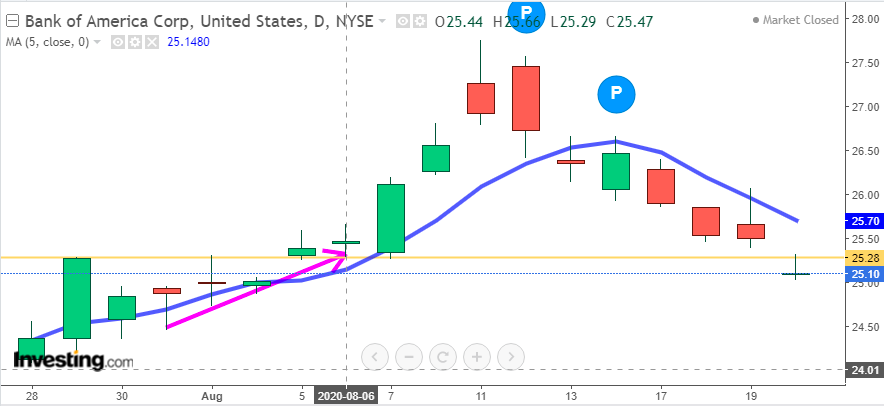
In the end of July 2020, we found the BAC stock price kept moving up. On 06-08-2020 or 07-08-2020, we decided to buy BAC stocks or Long Call options. The following timeline shows how the stock price and Call option premium (Expiration 16-10-2020 Strike price $31) floating over 10 trading days.
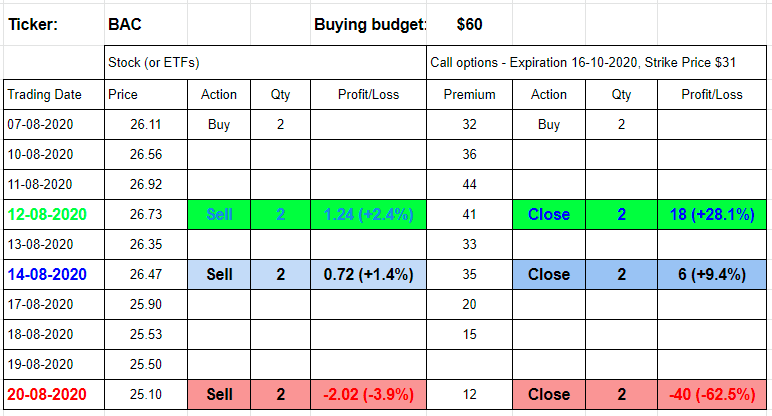
(1) When stock price falled on 12-08-2020, if we sold the stock or close the Long Call options, would profit +2.4% on stocks, or +28.1% on options.
(2) When stock price kept falling on 14-08-2020 and lower than its MA5, if we sold the stock or close the Long Call options, would profit +1.4% on stocks, or +9.4% on options.
(3) If we love the stock or the option and keep holding it, on 20-08-2020 would lose -3.9% on stocks, or -62.5% on options.
Do and do not, points to consider
(1) Do not LOVE any stock or option, trading is all about profit. Take profit and quit.
As the example above, if we closed the options on 11-08-2020, would gain near +37.5% profit. Although we don’t know that was the peak, if we were satisfied with +25% to +30% gain, we would own the profit.
(2) Do take stop-loss action when stock price falls under MA5.
(3) Options trading has very high risk. After placing trading order, do check the stock price and trend every day. Do configure stop-loss settings in trading software (or mobile app) to keep our money safe.
(4) Consider to close the option in 30 days before the expiration date. Don’t let the option expired to avoid any unexpected risk.
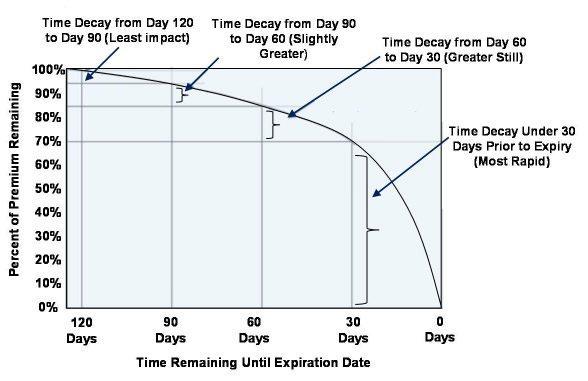
(5) Do not expect buying on dips, selling on peaks. Consider buying on averages, selling on averages.
Calculations
Find the ticker (stock/ETF) options information
We can find the options trading information from many websites:
(1) www.barchart.com
(2) finance.yahoo.com
(3) marketchameleon.com/
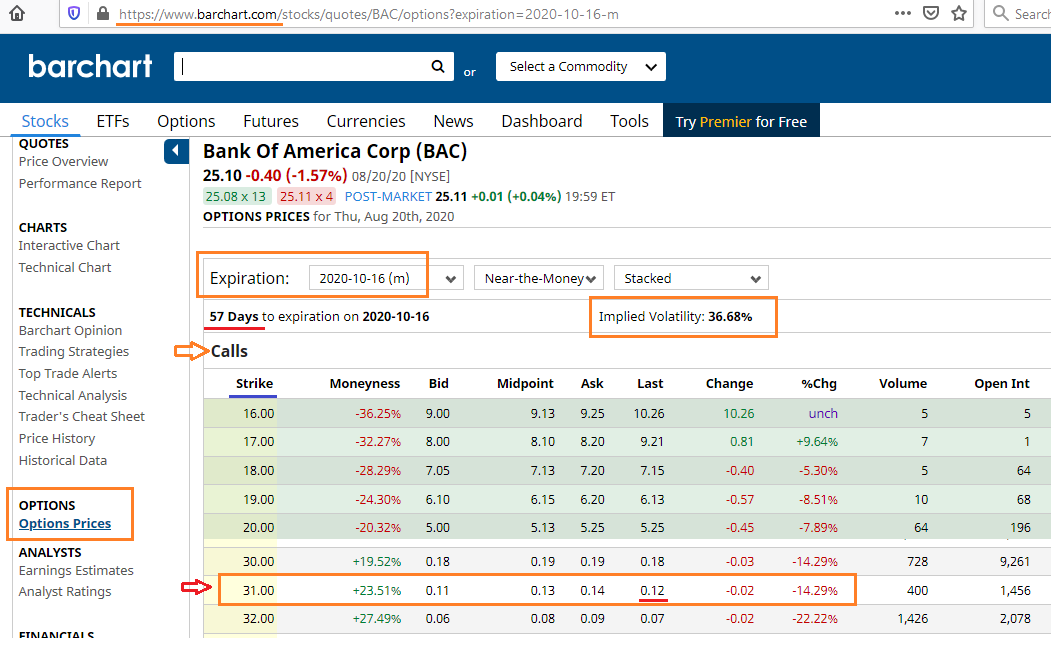
Here is the example to find option chains in barchart.com:
Charting
Input option data and click Calculate button. If no chart display, reload the page.Q1
| Ticker | |
| Price | |
| Option Expiration | |
| Strike price | |
| Premium | |
| Broker Commissions | |
| Ticker Implied Volatility(%) |
| Cost per contract (100 shares) | |
| Max Profit | |
| Profit or loss per share | |
| Max Loss | |
| Breakeven Point |
References
[1] Long Call by optionseducation.org
[2] Long Call by theoptionsguide.com
[3] Long Call by optionsplaybook.com
[4] Long Call Options Strategy (Best Guide w/ Examples) by projectoption
[5] Long Call Option Strategies by zacks.com
[6] Lawrence G. McMillan, Options As A Strategic Investment: 4th Edition Chapter 3, page 95-117
[7] 66 Option Trading Terms Explained by optionposts.com
[8] 5 steps to develop an options trading plan by fidelity.com
[9] Options Trading Strategy & Education by investopedia.com
[10] How to Use a Moving Average to Buy Stocks by investopedia.com
Question and Answer
Q1. Why the Proit/Loss chart does not display? Why we have to reload the page?
Answer: The Proit/Loss chart is created by the plotly.js which is about 3MB to load. It might not load properly when the page display, but would work when reloading the page.
I used the plotly for charting in some Python charting projects, so am more familiar with poltly settings. The simple, very small and good charting tool is Chart.js that is 105KB only. In fact, the Chart.js is good enough for creating options trading Profit/Loss chart.
Disclaimer:
I am NOT a financial advisor. I DO NOT provide personal investment advice. Any data and information here given are for informational, entertainment or educational purposes only and should not be construed as personal investment advice. All data and information are collected from open and free sources without verification, it may include errors or inaccuracies. I will NOT and CANNOT be held liable for any actions you take as a result of anything you read here. You trade at your own risk and nobody can guarantee you results. Please DO consult a licensed financial advisor or broker before making any investment decisions.
If my work and information are helpful, please buy me a coffee

:)-